
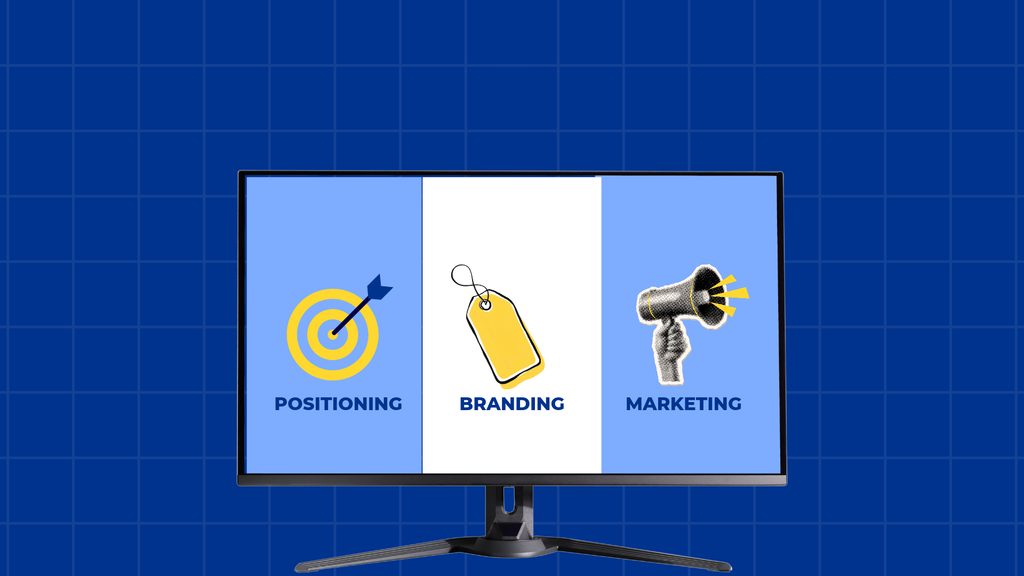
Many businesses say they need branding when what they actually need is positioning. Others invest in marketing when they have not yet established a clear brand identity.
The result is often the same: a new logo, a busy social media feed and sales that remain stagnant.
Although brand positioning, branding and marketing are closely related, they serve different purposes. Understanding these differences can help businesses make better strategic decisions and avoid spending money on activities that do not address their actual problems.
This guide explains what each concept means, what it delivers and why the order matters. By the end, you will understand which one your business needs to address first.
We draw on definitions from the American Marketing Association and the Chartered Institute of Marketing to explain these concepts and distinguish their roles.
Key Takeaways
- Brand positioning is the strategic decision about who you serve, what makes you different and why customers should choose you over the alternatives.
- Branding makes that position recognisable and memorable through your business name, visual identity, brand voice and customer experience.
- Marketing is the process of reaching potential customers, communicating value and winning their business. Advertising is only one part of it.
- The correct order is positioning first, branding second and marketing third. Each layer needs the foundation established by the one before it.
What Is the Difference Between Brand Positioning, Branding and Marketing?
Brand positioning determines where your business stands in the customer’s mind compared with competing alternatives. Branding makes that position recognisable through your name, identity and customer experience. Marketing communicates your value and connects your business with potential customers through different channels and activities.
In simple terms, positioning is the strategic decision, branding is the identity and marketing is how you communicate and deliver that value to the market.
Here is a breakdown of what each concept does.
| Brand positioning | Branding | Marketing | |
|---|---|---|---|
| Core question | Who are we for, and why should customers choose us? | How do we look, sound and feel so people recognise us? | How do we reach buyers and win their business? |
| What it produces | A positioning statement and competitive frame | A name, visual identity, brand voice and customer experience | Campaigns, content, distribution channels and sales support |
| What fails without it | Every message sounds like a competitor’s | A strong position has a forgettable identity | A strong brand struggles to reach its audience |
The table also illustrates why these three concepts should not be treated as interchangeable.
Each one builds on the previous layer. When positioning is unclear, branding has no specific strategic direction. Similarly, marketing becomes more expensive and less effective when there is no clear brand identity or message to communicate.
Understanding these distinctions is the first step towards building a more effective brand and marketing strategy.
What Is Brand Positioning?
Brand positioning is the strategic decision about the audience you serve, the alternatives you compete against and the reasons customers should choose your business.
It establishes the distinct place you want your brand to occupy in the minds of your target customers. More importantly, it gives your business a clear competitive direction.
Positioning is not a design asset or an advertising campaign. Instead, it is a strategic decision that guides how your business presents itself to the market.
A positioning statement captures this decision in a concise format. It identifies who you serve, the value you provide and what makes your offering different.
This distinction is important because brand positioning exists independently of your visual identity.
For example, a business can change its logo, colours or typography without changing its market position. However, if it has never established a clear position, its branding and marketing activities will lack a consistent strategic foundation.
We explain the entire process in our guide to the brand positioning framework, including how to identify your audience, establish your competitive advantage and express your position in one sentence.
Once you have made that strategic decision, the next step is to communicate it clearly. Here is how to write a positioning statement that your entire team can understand and consistently communicate without relying on a presentation.
What Is Branding?
Branding is the process of making a business recognisable and memorable through its name, identity and customer experience.
The Marketing Accountability Standards Board’s marketing dictionary, citing the American Marketing Association, defines a brand as any name, term, design, symbol or feature that distinguishes one seller’s offering from those of other sellers.
This definition highlights the identifying elements of a brand. These include its name, logo, visual appearance and other distinctive features.
However, branding goes beyond visual identification.
The Open University’s Marketing in the 21st Century course on OpenLearn discusses another dimension of the American Marketing Association’s definition. It describes a Brand, with a capital B, as a customer experience shaped by the images and ideas people associate with a product or service over time.
In other words, branding has two important dimensions:
1. Brand identity and identifiers.
These are the elements people use to recognise your business. They include your business name, logo, colours, typography, visual language and brand voice.
2. Brand experience and perception.
This covers how people experience your business at different touchpoints. It includes customer service, product quality, communication, delivery and the overall impression customers develop through their interactions with your brand.
Both dimensions contribute to how people recognise and remember your business.
However, neither one replaces positioning. A business can have an attractive visual identity and a memorable customer experience but still struggle to communicate why customers should choose it.
That is why branding should be built around a clearly defined brand position.
What Is Marketing?
Marketing is the process of understanding customers, communicating value and connecting a business’s offerings with the people who need them.
The Chartered Institute of Marketing defines marketing as the management process responsible for identifying, anticipating and satisfying customer requirements profitably.
This definition is important because it shows that marketing involves much more than advertising or selling.
Marketing covers several interconnected activities, including:
- Product: Developing products or services that meet customer needs.
- Price: Establishing pricing that reflects customer value and business objectives.
- Place: Determining how and where customers can access your offering.
- Promotion: Communicating your value through advertising, public relations, content, social media and other promotional activities.
Together, these elements are commonly referred to as the marketing mix.
The CIM also highlights a common misconception: many people assume marketing is simply advertising or selling. However, these activities represent only part of a much broader process.
For example, a business must first understand its market, identify customer needs, develop an appropriate offering and establish how to communicate its value. Advertising then becomes one of the tools used to reach potential customers.
Marketing also depends on the other two layers.
Without clear positioning, your campaigns lack a distinctive message. Similarly, without consistent branding, your marketing activities struggle to build recognition and familiarity.
This is why marketing should not operate independently of your brand strategy.
In What Order Should You Do Positioning, Branding and Marketing?
The recommended order is brand positioning first, branding second and marketing third.
Positioning gives branding a strategic direction. Branding then gives marketing a recognisable and consistent identity to communicate.
When businesses reverse this order, they risk investing in visual identities and campaigns that have no clear competitive message.
Consider an illustrative scenario involving a hypothetical logistics startup.
The company hires a designer first and receives a sleek logo, a modern visual identity and a bold colour palette.
Next, it launches advertising campaigns with the promise of “fast and reliable delivery.”
However, every competitor makes a similar promise. Consequently, the startup struggles to stand out despite having invested in its branding and advertising.
Now, imagine the same business taking a different approach.
Before hiring a designer, it identifies its target audience as online fashion sellers who ship small parcels regularly. It also establishes that its advantage is providing a more convenient and reliable alternative to manually coordinating dispatch riders.
With this positioning in place, the branding can communicate the company’s specialist focus. Its visual identity, messaging and customer experience can all reinforce that position.
The marketing campaigns can then speak directly to the challenges online fashion sellers face.
The result is a more focused business with a clearer message, even if its advertising budget remains unchanged.
Our take (opinion): Many businesses skip positioning because it does not produce an immediately visible asset. A logo is tangible. A colour palette is visible. A positioning decision, on the other hand, exists primarily in the strategy behind the business.
However, we believe positioning is the better first investment because it determines what the other activities should communicate. This is a strategic argument, not a claim based on measured campaign data.
Which Does Your Business Need First: Positioning, Branding or Marketing?
The easiest way to determine what your business needs is to examine the problems you currently face.
Each problem often points to a different strategic weakness. Therefore, understanding the symptoms can help you identify where to focus your resources.
1. Your team struggles to explain what makes your business different.
This is likely a positioning problem.
If your team cannot clearly explain who your business serves, what makes your offering different and why customers should choose you, investing in a new logo or advertising campaign will not solve the underlying issue.
Start by defining your audience, identifying the alternatives they consider and establishing the value your business delivers.
2. Customers understand what you do but struggle to remember your business.
This may indicate a branding problem.
Your positioning might already be clear, but your visual identity, brand voice and customer experience may not be distinctive or consistent enough to make your business memorable.
In this situation, focus on building a recognisable brand identity and ensuring that customers have a consistent experience across different touchpoints.
3. Your offering is strong, but very few potential customers know your business exists.
This is likely a marketing problem.
Your business has a clear value proposition and a recognisable identity, but it is not reaching enough of the right people.
You may need a more effective marketing strategy involving content marketing, social media, advertising, partnerships, search engine optimisation or other relevant distribution channels.
The important thing is to identify the actual problem before deciding where to spend your money.
At Crystal Mediatech, a content marketing and brand positioning agency in Nigeria, we work with businesses in Nigeria and remotely with teams across other countries and continents.
Our approach starts with the first layer because positioning provides the strategic foundation for the other two. Once we understand where a business wants to compete and why customers should choose it, we can develop branding and marketing strategies that support that direction.
If you want to see how we combine strategic thinking with consistent publishing, explore our positioning and content services.
Not sure whether your business has a positioning, branding or marketing problem? Talk to us. We will help you identify what needs attention and where to start.
3 Responses